Wednesday, April 25, 2012

Tong-len and the Four Immeasurable Thoughts

By Lama Zopa Rinpoche - August 2009

Rinpoche gave the following advice on how to do the preliminary practice of tong-len

Tong-len: This is the practice of taking and giving, the most brave practice of bodhicitta. One way of doing this practice is by reciting verse 95 in the Lama Chöpa:

Tong-len: Meditation on Taking and Giving

LC 95: And thus, venerable, compassionate gurus,
I seek your blessings that all karmic debts, obstacles, and sufferings of mother beings
May without exception ripen upon me right now,
And that I may give my happiness and virtue to others
And, thereby, invest all beings in bliss.
You recite this verse according to the number you need to recite, and, at the same time, do the meditation. Each time you do this, you collect limitless skies of merit. It is an extremely powerful purification method, and you become closer to enlightenment.

This practice helps to develop bodhicitta. This is a most brave practice to generate bodhicitta.

Or, you can base the recitations on a verse from Nagarjuna’s teachings:

“Whatever sufferings there are, may they ripen on me; whatever happiness I have, may it ripen on sentient beings.”
With the first part, you do the practice of taking. With the second, you do the practice of giving. Then, you count on the mala (each time you recite the verse). I think you will be blissed out from this practice and sentient beings will be blissed out.

About the Preliminary Practice of Tong-len

This is a most powerful practice to do. (This is reciting the requesting prayer, together with the meditation of giving and taking.) Here, each time you take the sufferings and the causes of sufferings, including the negative imprints, take all sentient beings’ sufferings, including the delusions and karma, together with the negative imprints, and also the undesirable environments. For example, in hell, there is the ice fire, the ice mountain, the burning ground, the iron house; then, for the pretas, it is a very depressing place with no water, and is so hot and so cold; for human beings, it is a very dirty place full of thorn bushes. You take the environmental sufferings as well, those kinds of things, in the form of black pollution, and you give it to the ego and destroy the ego – one’s own worst enemy. This is the greatest demon that has interfered so far with your being able to achieve enlightenment. It hasn’t allowed you to achieve enlightenment so far, besides that, it hasn’t even allowed you to achieve liberation from samsara, and hasn’t allowed you to enlighten all sentient beings, not even one. In these ways, you can see that one’s own ego is somehow the enemy of all sentient beings, not only an enemy to you.

Saturday, April 21, 2012

Masters of Mercy


Between 1854 and 1863, Japanese artist Kano Kazunobu (1816-1863) created a series of 100 paintings of the Buddha’s 500 disciples. Very early Buddhist sacred texts suggested that during one of the Buddha’s famous sermons, 500 followers received instant enlightenment. These disciples became known as “the worthy ones,” and fascination with them was a staple of Japanese Buddhist iconography. Kazunobu interpreted this ancient idea of “the worthy ones” and intertwined with it popular themes from his own era to create lively, richly colored, and highly detailed scenes of the disciples. His 19th century scroll paintings range from depictions of monastic life and duties to images of the disciples performing miracles, such as saving people from hell or relieving a drought. Watch our interview about Buddhism and Kazunobu’s paintings with James Ulak, senior curator of Japanese art at the Smithsonian Institution’s Freer Gallery of Art and Arthur M. Sackler Gallery. Masters of Mercy: Buddha’s Amazing Disciples is on display through July 8, 2012 at the Sackler Gallery in Washington, DC. Produced by Jonathan Stroshine and Lauren Talley. Interview by Lauren Talley. Edited by Lauren Talley and Fred Yi.


Watch Masters of Mercy on PBS. See more from Religion & Ethics NewsWeekly.

JAMES ULAK (Senior Curator of Japanese Art, Smithsonian Institution’s Freer and Sackler Galleries): These are the designated closest disciples of the living Buddha in the time in the fifth century before the Christian era when he preached his message in what is now northeast India.

These close followers who later received the canonical number of five hundred became known as the “worthy ones.” In Sanskrit, the language of the day in India, Sanskrit calls these people arhats. You hear different names applied to these five hundred. The point of Buddhist fascination with these five hundred followers is that they take the role of intercessors and messengers from the Buddha, teaching compassion, showing that the Buddha’s life can be lived on earth, and they take on the role of supermen. The idea was that they were enlightened but yet living among us. And so they were able to show us how to live but yet also conduct these intercessory miraculous acts to save us from our sufferings.


Friday, April 20, 2012

When We Eat Meat

By Bokar Rinpoche

Eating meat from a killed animal is a negative deed. It is better not to eat any meat at all.

If, however, because of circumstances, we cannot abstain from eating meat, at least we must avoid causing an animal to be killed for our consumption. We must not order a live animal to be killed for ourselves.

Meat bought at the butcher comes from animals killed for general consumption and not directly from an order we have given. Eating this meat is also a negative deed but it is less serious.

When we eat meat, we must direct our compassion toward the animal that was killed, recite the Names of the Buddhas, Chenrizig mantra, or other mantras, and blow on the meat. We wish at the same time that the animal be delivered from inferior realms and be born into the Land of Bliss.

Doing this not only brings help to the animal but also diminishes the strength of negative karma accumulated through eating meat.

From: The Day of a Buddhist Practitioner


For  a more thorough teaching on abstaing from meat in Buddhism and Dzogchen, see:
 
Food of Bodhisattvas: Buddhist Teachings on Abstaining from Meat 
 
By Shabkar


Also of related intrest: 

Shabkar.org is a non-sectarian website dedicated to vegetarianism as a way of life for Buddhists of all schools

Wednesday, April 18, 2012

Stress and Work

Questions and Answers

by Thich Nhat Hanh

Q: How do you maintain mindfulness in a busy work environment? At times it seems there is not even enough time to breathe mindfully.

A: This is not a personal problem only; this is a problem of the whole civilization. That is why we have to practice not only as individuals; we have to practice as a society. We have to make a revolution in the way we organize our society and our daily life, so we will be able to enjoy the work we do every day.

Meanwhile, we can incorporate a number of things that we have learned in this retreat in order to lessen our stress. When you drive around the city and come to a red light or a stop sign, you can just sit back and make use of these twenty or thirty seconds to relax-to breathe in, breathe out, and enjoy arriving in the present moment. There are many things like that we can do. Years ago I was in Montreal on the way to a retreat, and I noticed that the license plates said Je me souviens-"I remember." I did not know what they wanted to remember, but to me it means that I remember to breathe and to smile (laughter). So I told a friend who was driving the car that I had a gift for the sangha in Montreal: every time you see Je me souviens, you remember to breathe and smile and go back to the present moment. Many of our friends in the Montreal sangha have been practicing that for more than ten years.

I think we can enjoy the red light; we can also enjoy the stop sign. Every time we see it we profit: instead of being angry at the red light, of being burned by impatience, we just practice breathing in, breathing out, smiling. That helps a lot. And when you hear the telephone ringing you can consider it to be the sound of the mindfulness bell. You practice telephone meditation. Every time you hear the telephone ringing you stay exactly where you are (laughter). You breathe in and breathe out and enjoy your breathing. Listen, listen-this wonderful sound brings you back to your true home. Then when you hear the second ring you stand up and you go to the telephone with dignity (laughter). That means in the style of walking meditation (laughter). You know that you can afford to do that, because if the other person has something really important to tell you, she will not hang up before the third ring. That is what we call telephone meditation. We use the sound as the bell of mindfulness.

And waiting at the bus stop you might like to try mindful breathing, and waiting in line to go into a bank, you can always practice mindful breathing. Walking from one building to another building, why don't you use walking meditation, because that improves the quality of our life. That brings more peace and serenity, and the quality of the work we do will be improved just by that kind of practice. So it is possible to integrate the practice into our daily life. We just need a little bit of creative imagination to do so.

[JUMP TO ORIGINAL]

Plum Village


Tuesday, April 17, 2012

Benefits of the Vajra Guru Mantra


And an Explanation of its Syllables
A Treasure Text Revealed by Tulku Karma Lingpa

I prostrate to the Guru, the Yidam and the Dakini.
I, the lowly woman Yeshe Tsogyal, made a great outer, inner and secret mandala offering and humbly asked:
 “O, Master Lotus Born, the work you have done for the welfare of all sentient beings here in Tibet, in this and in future lives, is vast. No one of such extreme kindness has ever come before, nor shall any come again. The practices you have given us are like essential nectar; though I am a lowly woman, of this I have no doubt. However, sentient beings in the future will have profuse thoughts and tremendous aggression; they will have wrong views towards the Holy Dharma, and in particular they will blaspheme the supreme teachings of the Secret Mantra. At that time, plague, famine and war will be widespread amongst sentient beings, and in particular, China, Tibet and Mongolia will be destroyed like ants’ nests, and a time of terrible suffering will befall the Tibetans.
“You have spoken of many ways to remedy these afflictions, but beings in the future will have no time to practice. Those who do have a slight inclination towards practice will be beset by powerful obstacles. Beings will not get along with one other; supplies and materials will be insufficient. Such terrible times as these will be extremely difficult to avert. In such times, Guru, what are the benefits of relying solely upon the practice of the Vajra Guru mantra? For the benefit of people of weak intellect in the future, I humbly entreat you to tell us.”
 The Master Lotus Born spoke thus:
 “O, Lady of Faith, what you say is absolutely true. In such future times, that practice will definitely be of short and long term benefit for sentient beings. Although I have concealed many earth treasures, water treasures, rock treasures, sky treasures and so on which contain unfathomable pith instructions and methods of practice, in the degenerate times it will be terribly difficult for fortunate beings to find the conditions and circumstances to meet with the teachings; this is a sign that beings’ merit is running out.
 “However, in such times as those, this essential Vajra Guru mantra—if recited with vast bodhicitta aspiration in great sacred places, in monasteries, on the peaks of high mountains and the shores of vast rivers, in places inhabited by gods, demons and evil spirits, at the heads of valleys, geophysical junctions and so on—by ngakpas with unbroken samaya, vow-holding monastics, faithful men, women of fine qualities, and the like, however many times—one hundred, one thousand, ten thousand, one hundred thousand, ten million, one hundred million, etc.—will bring inconceivable benefits and powers. Countries everywhere will be protected from all plague, famine, warfare, armed violence, poor harvests, bad omens and evil spells. Rain will fall on time, harvests and livestock will be excellent, and lands will prosper. In this life, future lives, and on the pathways of the bardo, fortunate practitioners will meet me again and again—at best in actuality, or else in visions, and at the very least in dreams. Having gradually perfected the levels and paths, there is no doubt that they will join the ranks of male and female Awareness Holders in Ngayab Ling.
 “Even one hundred recitations per day without interruption will make you attractive to others, and food, wealth and enjoyments will appear effortlessly. If you recite the mantra one thousand, ten thousand, or more times per day, you will bring others under your influence with your brilliance, and blessings and powers will be continuously and unobstructedly obtained. If you perform one hundred thousand, ten million or more recitations, the three worlds will come under your power, the three levels of existence will fall under your glorious sway, gods and spirits will be at your bidding, the four modes of enlightened activity will be accomplished without hindrance, and you will be able to bring immeasurable benefit to all sentient beings in whatever ways are needed. If you can do thirty million, seventy million or more recitations, you will never be separate from the Buddhas of the three times nor ever apart from me; thus, the eight classes of gods and spirits will obey your orders, praise your words, and accomplish whatever tasks you entrust to them.
 “At best, practitioners will attain the rainbow body; failing that, at the time of death, mother and child luminosities will meet; and at the very least, they will see me in the bardo and all their perceptions having been liberated into their essential nature, they will be reborn in Ngayab Ling and accomplish immeasurable benefit for sentient beings.”
 Thus he spoke.
 “Great Master, thank you for telling us about such infinite benefits and powers. You have been immensely kind. Although the explanation of the benefits and powers of the syllables of Guru Padma’s mantra is unfathomable, for the sake of sentient beings in the future, I humbly ask you to give us a brief description,” she asked.
 Then the Great Master spoke thus:
 “O, Noble Daughter, the Vajra Guru mantra is not only my essential mantra, it is the life-essence of the deities of the four classes of tantra, the nine vehicles, the 84,000 aspects of the Dharma, and so on. The heart essence of all the Buddhas of the three times, the lamas, deities, dakinis, Dharma protectors, and the like is encompassed by this mantra. The reason for this is as follows. Listen well and hold this in your heart. Recite the mantra. Write it. Tell it to sentient beings in the future.

What is a Tsok


Tsok means gathering. We gather together the things we're offering, and we ourselves gather together to do the practice. Gathering together with other practitioners, concentrating our minds into the same space, gives us great inspiration. It's much better than just doing puja alone in our own rooms. This is the Tibetan connotation of tsog.

An example from my college at Sera likens a group puja to a straw broom. You can't sweep much floor with just one straw, but when many straws are gathered together to make a broom, you can clean an entire assembly hall in no time at all. We are not as strong as distinguished practitioners such as Milarepa. He was okay by himself, we are not ready for that yet.

So it's good that we come together trying to develop single-pointedness of mind; one hundred people's minds all meeting at the same place. This becomes very powerful.

Tsok in the Tibetan tradition is a most profound method of purification, a profound way of gaining realisations. When you recite the text in English you can see how many subjects are included in the practice. The Guru Puja, for example, covers the entire path to enlightenment from beginning to end. 

So it can happen that in your daily meditations you're not making any obvious progress, then suddenly during a puja, because of the conducive atmosphere you've created, zoom! -- some realisation comes into your mind. Many people have gained realisations during a puja simply because of the atmosphere.

Normally, we push ourselves to achieve, but nothing happens because we've not made the space for something to happen. By gathering together to offer tsok we're making space. When the right space opens, zoom! - realisations come as if magnetically attracted. This is true.

Thus, to gain realisations we need to create the right atmosphere. We do this by gathering together and directing our minds to the same place. The power of this practice brings understanding. I think it's great: we're an international gathering and each of us has developed in our own unique way; but despite our differences our minds can still meet at the same place and we can communicate with each other. I really think it's wonderful. Parents may not be able to communicate with their children but here we are from different countries all over the world and we're able to communicate with each other, heart to heart.

Another connotation of tsok is 'party' - a party at which we share simultaneously born great wisdom and bliss. Now that's a party.

Guru Rinpoche Tsok

Throughout the world, Vajrayana Buddhist practitioners of the Nyingma and other traditions celebrate the Guru Rinpoche Tsok on the 10th day. Guru Rinpoche, commonly known as Padmasambhava, brought Buddhism to Tibet is considered a second Buddha.

During the Tsok Ceremony, along with meditation and prayers, we will make offerings of many things, including flowers and various foods brought by the participants. Food offerings can include many types of food. (see picture of typical offerings). Through meditation and mantra recitation, the offerings are consecrated and offered to the invoked gathering of enlightened beings, to bless sentient beings and free them from suffering. At the end of the ceremony, the food and drink are shared by all, and the merit which has been generated is dedicated for the benefit of all beings.

It is said that a single day of practice on a tenth day is more powerful than a year of practice at any other time.

This year the anniversary of Padmasambhava's birth is especially auspicious as it is a monkey year, which according to the Tibetan calendar occurs only once every twelve years. 


Monday, April 16, 2012

Buddhism seeks to explain suffering in life

April 14, 2012

By Ajaan Piya

Some people view Buddhism as pessimism. They call it the "religion of misery," because the word "suffering" or "unsatisfactoriness," which the Buddha taught in his first four noble truths, sticks in their minds.

Actually, Buddhism is not pessimism nor optimism. Buddhism is realism, a way to see things as they really are. The Buddha taught us about life from our birth till death. It covers many areas of life, such as how to live wisely and happily, how to win friends, how to accomplish our goals, and even how to die peacefully.

Why is Buddhism always talking about suffering? That is the truth of life we all have to accept and recognize in order to cure it. The Buddha did not speak about suffering only, but how to overcome suffering. That is happiness in life.

Let me share with you the secrets of happiness. There are three steps to follow.

The first step is to be happy or to enjoy whatever you do

Abraham Lincoln said, "My father taught me to work; he did not teach me to love it." Most of us do not enjoy what we have and do, especially our work. Sometimes we depend on our like or dislike emotions too much. We do things because we feel good or like it. A lot of times we refuse and suffer if someone forces us to work. The problem is how are we going to love or be happy with the things we do.

In Buddhism, "Kuttukammayatachandha" means the willingness to do things. If we don't enjoy whatever we're doing, imagine what's going to happen. We will work eight hours a day and not enjoy it. Instead, we will hate and suffer, which I think is not healthy for body and mind.

Why don't we train ourselves to take pleasure in everything we do? There is the saying, "If you do not have the thing that you like, you have to like the thing that you have."

We have to train ourselves to love and see the positive side of things that come toward our everyday lives as a lesson. When you wake up in the morning, think that it is a great day and I'm still alive. I have a chance to do good and enjoy one more day. When you are having breakfast, enjoy that, and try the best you can to apply that to each daily moment. This is the first step to happiness.

The second step is mindfulness

There is a saying, "The lights are on, but nobody is home." We are all in the information technology era and have a lot of convenient tools that make life easy. Sometimes we aren't even aware of doing things and we behave like a robot. We live by our old habits and are not mindful.

When you are eating, make sure you are enjoying your food, not thinking or planning. We must change our old habits, especially the natural habits in which we do things in life automatically.

If you are walking, do you know right now you are walking. In a practical way you have to know each moment, whether it is good nor bad. If you are angry, know that you're angry; if you're happy, know that you're happy. Whatever you do — sit, stand, shower, have coffee, talk, and so on — add knowing or mindfulness.

Where is your mind? Is it absent? In order to gain happiness, you must bring our mind back to the here and now, and be mindful of each moment in life. Our mind and body are together, so try not to let your mind wander often. In the Buddha way, mindful action is the most important training. All teachings of the Buddha sum up to mindfulness. Be mindful, then you practice all the Buddha's teachings.

The third step is concentration

In Buddhist countries, there are a lot of Buddha statues. One of the statue postures that is very famous is the meditation posture. In Pali, we call it the "Samadhi posture," which means concentration. When Buddhist followers see this statue, it reminds them that you should concentrate and focus on whatever you do. When you sleep or when you eat, concentrate on eating or your mind with that eating.

Do you observe yourself doing things? Can you really focus or concentrate ? It is difficult, right ? Sometimes we do a lot of things at the same time. We ponder that we are smart, that we can do a lot of things such as watching a TV show and calling our friends at the same time. Is there a quality of doing like that? I think it is not such a good habit to be like that, especially when you drive and text or drive and talk. It can cause problems. Concentration is another key to happiness and success in life.

These are the secrets to happiness; enjoy, be mindful, and concentrate. If you follow these steps hour by hour and day by day, your practice will get stronger and strongerBut you have to begin right now to change and start new way.

Enjoy the journey to happiness.

Tawachai Onsanit is one of the founding members of Wat Pasantidhamma temple in Carrollton. Inquiries may be addressed to Ajaan Piya at p_kind_j@yahoo.com.


[JUMP TO ORIGINAL]

Buddha Nature: 5 Tips In Tibetan Buddhism For Opening Your Heart And Mind

By Tsoknyi Rinpoche

1. Remember Who You Are

Deep within all beings is a kind of spark that lights and warms our lives. It's been called by many names in many different traditions. In the Buddhist tradition it's known as "Buddha nature"-- which is often described in terms of three qualities: boundless wisdom, infinite capability, and immeasurable loving-kindness and compassion.

One of the core teachings of Buddhism is that we all possess this nature. You may think that you're an accountant, an executive, a teacher, a student, a parent, a child -- and indeed, on a mundane, every-day level, you are. But underneath a particular identity and all the thoughts, feelings, and behaviors that may attach to it, what you are is the ever-evolving potential of a being who is capable not only of transcending suffering but of leading all other creatures out of darkness and pain, as well.

So all you really have to do in order to open your heart and your mind is to remember your Buddha nature!

2. Mind Your Body

Unfortunately that's not always easy. Throughout our lives we're urged to define ourselves and our experiences in particular ways. Over time, these definitions become so familiar that we end up identifying with them completely as the absolute truth of who we are.

We can, however, begin to break down our mundane, everyday identities into smaller pieces -- a process through which we begin to discover that who we think we are isn't quite as solid as we believe. One of the easiest ways to begin is to spend a little time with our bodies.

It's surprising how many of us forget our bodies. It's so easy to get caught up in thoughts and feelings and overlook this extraordinary system of muscles, bones, organs and so on that serves as a physical support for our thoughts, feelings and behaviors.

So one thing we can do -- preferably while sitting in a comfortable position with the spine straight and muscles relaxed -- is to start simply and gently appreciating that we have a body, a basic ground of experience. We can begin by simply noticing: "There is a leg. There is a toe." We can simply notice, too, that there is a heart that is beating; there are lungs that are expanding and contracting; there is blood coursing through veins. We can also notice physical sensations such as being cold or being warm, feeling pain in the knees, back or shoulders, and so on. The point of the practice is to simply allow ourselves to become alert to the physical aspect of our being in a very easygoing and gentle way, without judging it or identifying with it.

3. You Are Not Your Feelings, You Are Not Your Thoughts

We've become so used to the potency, frequency and variety of the thoughts and feelings that course through our awareness throughout the day that it's very easy to identify with and as them. This tendency is built into our very language. "I'm angry." "I'm afraid." "I'm happy. "I'm sad."

We can bring the same kind of attention we brought to our bodies to our thoughts and feelings -- gently noticing them as they arise, abide for a moment and, somewhat to our surprise perhaps, disappear. In so doing, we gently begin to recognize that our thoughts and feelings are only aspects of experience and not the totality. Our identities may be may be influenced by mental and emotional patterns in the subtle body, but we are not those patterns.

Try practicing this sort of gentle noticing the next time you feel a strong emotion. Allow the emotion to arise, but look at it as an event occurring within a broader frame of awareness. Tell yourself that what ever you're experiencing is not the total "you," that what you're feeling is only one piece of your experience.

We can also bring this same sort of attention to our thoughts which are often intimately linked to our identities. The speed with which thoughts appear and disappear across the screens of our minds are like out-of-control "breaking news update crawlers" that appear across television screens. We can hardly read one before another takes its place -- and another and another. Our awareness is overwhelmed by fleeting impressions, half-grasped notions, bits of sentences, ideas that have only begun to form before they disappear.

As we gradually turn attention to our thoughts, rather than being irritated, disturbed or carried away by them, we slowly find ourselves amazed by their coming and going. We begin to appreciate the entire process of thinking in and of itself.

4. Rest In Space

In time, we also begin to notice gaps between thoughts and feelings -- barely perceptible moments in which there is simply no thought, no feeling, just pure, open awareness. As these gaps grow longer -- and a little less startling -- we can begin to rest within them. For a brief second or so, we can have a direct experience of what in the Buddhist tradition is known as the essence of mind, or the nature of mind: a luminous, limitless awareness that is not chopped up into subject and object, self and other, perceiver and perceived. All distinctions between "the looker" and what was being "looked at" fall away, and for an instant we experience complete lack of separation between everything we feel, see, smell, and so on, and the awareness that sees, smells and feels. Our hearts and minds are completely open, and the spark that is our Buddha nature leaps up into a brilliant flame.

5. Share the Bliss

Unfortunately, it's easy to get caught up in the sense of well-being that arises when our hearts and minds open and to forget the most essential lesson that the Buddha tried to instill in us as the deepest of all teachings: that until all of us are free, none of us are free. Rather than rest in our own comfort zones, our contentment dimming our awareness of the pain and hardship that others around us may be feeling, we must remember that the ultimate goal of opening our hearts and minds is to free all living creatures from their patterns so that they can experience the openness, wisdom, and warmth that is the essence of our being.

Buddha nature is infinite; beings in need of awakening are infinite; and our journey, once begun, is never done

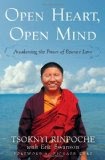
Open Heart, Open Mind: Awakening the Power of Essence Love
by Tsoknyi Rinpoche, Eric Swanson


[JUMP TO ORIGINAL]

Sunday, April 15, 2012

A Complete Set of Instructions for the Bardos


Crucial Advice: A Complete Set of Instructions for the Bardos
by Longchen Rabjam

At the feet of the sacred master, respectfully I pay homage!
Although you have gained this life of freedom and advantage, it will not last,
So keep in mind these instructions for the moment of death.

Now, during this intermediate period of the bardo of this life,
Decide, with complete certainty, that the wisdom of your own awareness is dharmakaya,
And sustaining the ongoing experience of its self-radiance, the meditation which is naturally clear,
Everything will only enhance naturally arising wisdom!

During the bardo of dying, when the four elements dissolve,
There will be the illusory experiences of rising and falling, shaking, and haziness.1
And the dissolution of earth, water, fire, wind and space.
 
The sense faculties too will cease to function. At that time, remind yourself:
“Now I am dying, but there is no need to fear.”
 
Examine: “What is death? Who is dying? Where does dying take place?”
Death is merely the return of borrowed elements.
 
In the face of rigpa itself, there is no birth or death.
 
Within the very formof the dharmakaya of primordial purity, the union of rigpa and emptiness,
Examine: “What is death? Who is dying? Where does dying take place?”
 
As dying exists nowhere, it is absolutely unreal.
 
In the experience of this, generate courage and confidence.
The arising of rigpa is not obstructed in any way.
 
Earth, water, fire, wind and consciousness dissolve into space.
When space dissolves into pure luminosity,
The six consciousnesses dissolve into the basis of all, the dharmadhatu,
As awareness parts from the inanimate, there is an experience of pure awareness, devoid of phenomena.
 
Separated from the ordinary mind, the great primordial purity of dharmakaya dawns.
Through having recognized this here and now in training,
You will be freed directly, in a single instant.
 
And gain the dharmakaya of twofold purity.

Saturday, April 14, 2012

A Brief Introduction to the Bardos


Generally, whenever physically embodied beings die, they first experience the twenty phases of coarse dissolution, which are as follows:
1. As the aggregate of form dissolves, the limbs twitch, and the body loses its strength and power.
2. As the mirror-like wisdom dissolves, the mind grows unclear and hazy.
3. As the earth element dissolves, the body grows dry.
4. As the eye faculty dissolves, sight becomes unclear and the eye takes on a rounder shape.
5. As the object form dissolves, the body loses its vitality and weakens.
6. As the aggregate of sensations dissolves, the dying person can no longer detect feelings.
7. As the wisdom of equality dissolves, there is no longer any awareness of the three types of sensation (i.e., pleasant, painful or neutral).
8. As the water element dissolves, the lips, sweat, urine, semen and ovum all dry up.
9. As the ear faculty dissolves, external and internal sounds can no longer be heard.
10. As the object sound dissolves, the sounds of the body itself can no longer be heard.
11. As the aggregate of perception dissolves, it is no longer possible to distinguish between different creatures. 1
12. As the wisdom of discernment dissolves, the dying person forgets the names of his or her own parents, siblings or children.
13. As the fire element dissolves, proper digestion of food is no longer possible.
14. As the nose faculty dissolves, upper respiration 2slows.
15. As the object smell dissolves, the person can no longer detect the odours of their own body.
16. As the aggregate of formations dissolves, the person is unable to carry out physical activities.
17. As the all-accomplishing wisdom dissolves, the person can no longer remember ordinary mundane tasks or their purpose.
18. As the wind element dissolves, the ten internal winds shift from their usual locations.
19. As the tongue faculty dissolves, the tongue feels thicker and shorter than usual and turns blue at its base.
20. As the object taste dissolves, the person can no longer detect the six kinds of taste.
Following the twenty coarse forms of dissolution, which unfold in this way, comes the process of subtle inner dissolution:
As earth dissolves into water, the person is unable to move the body and can no longer maintain its strength. 3It feels as if the body is sinking into the ground. As an inner sign, there is a shimmering expanse of blue, and the impression of softly drizzling rain and flowing water.
As water dissolves into fire, the mouth and nostrils dry up, and the tongue becomes lodged against the palate. As an inner sign, there is an appearance of a smoky haze swirling on a plain.
As fire dissolves into wind, the body loses heat in its extremities, and the stomach's digestive energy grows weaker. As an inner sign, shimmering red sparks crackle and flicker like fireflies.
As wind dissolves into consciousness, exhalations become longer, and, as the coarse outer breathing ceases, the person is unable to inhale. As an inner sign, there is a vision of a burning lamp, and many torches arranged in a row.
As consciousness dissolves into space, as an inner sign, awareness is very clear, and as an outer sign, there is an experience like the sky devoid of clouds. 4
Then, as space dissolves into luminosity, four visions gradually unfold:
1. The white essence obtained from the father descends from the crown, and when it reaches the heart there is what is called 'appearance'. As an outer sign, this is accompanied by an experience of whiteness, as when moonlight fills a completely clear sky that is entirely free from clouds. As an inner sign, there is a clear experience of the self-clarity of consciousness devoid of any coarse thought states focused on perceived objects.
2. As the subtle red element of the mother ascends from the base of the central channel, the wisdom of appearance fades into 'increase'. As an outer sign, a red vision unfolds like a cloudless sky pervaded by sunlight. As an inner sign, there is an extremely clear state of mind devoid of any coarse thought states focused on the perceiving subject.
3. As the subtle white and red essences meet at the heart, the wisdom of increase dissolves into 'attainment'. Through this, as an outer sign, there is an experience of blackness, like the thick darkness which falls when the sky turns completely black. As an inner sign, extremely subtle thoughts involving perceived objects and perceiving subject become completely absent, and all distinct concepts based on the appearance aspect of mind fade away, so that, as the ordinary dualistic mind ceases, the wisdom of attainment dawns.
4. When the the subtle essences of blood and breath, the bindus A and HANG 5and so on, which are inside the white, silken thread-like channel in the heart, all dissolve completely, the ground luminosity of the moment of death arises. As an outer sign, there is an experience of emptiness and clarity without centre or periphery, like a cloudless sky when it is completely clear. As an inner sign, you remain in co-emergent, non-conceptual wisdom that is entirely without elaboration. If, having recognized this, you can settle into an ongoing experience of the present moment, mother and child luminosities will meet together, and you will be liberated in the first bardo.
In this context, empty luminosity is explained according to the general approach of the tantras, whereas how the forms of the deities arise out of clear light, how the tikles of light and so on appear are explained in the Dzogchen tantras. Nevertheless, it would seem to be rare for these to unfold in a way that provides an opportunity for liberation. 6
Next, out of the luminosity into which the three visions dissolved, appearances unfold gradually once again, and the body of the bardo of becoming is formed. For the first half of this bardo, however long that might be, you have the form of your preceding life, and for the second half you take on the appearance of your eventual rebirth. All sensory faculties are intact, and you can travel anywhere but the mother's womb, miraculously and without obstruction. You are invisible to all except those of the same class (i.e. other bardo beings) and those who have obtained divine vision. Since you have taken on something like a body in a dream, for example, which is generated in an instant, and knows neither light nor complete darkness, this is known as the 'bardo of semi-darkness'.

Thursday, April 12, 2012

Advice from Me to Myself

Patrul Rinpoche (1808-1887)


Vajrasattva, sole deity, Master,

You sit on a full-moon lotus-cushion of white light

In the hundred-petalled full bloom of youth.


Think of me, Vajrasattva,

You who remain unmoved within the manifest display

That is Mahamudra, pure bliss-emptiness.


Listen up, old bad-karma Patrul,

You dweller-in-distraction.


For ages now you’ve been

Beguiled, entranced, and fooled by appearances.

Are you aware of that? Are you?

Right this very instant, when you’re

Under the spell of mistaken perception

You’ve got to watch out.

Don’t let yourself get carried away by this fake and empty life.


Your mind is spinning around

About carrying out a lot of useless projects:

It’s a waste! Give it up!

Thinking about the hundred plans you want to accomplish,

With never enough time to finish them,

Just weighs down your mind.

You’re completely distracted

By all these projects, which never come to an end,

But keep spreading out more, like ripples in water.

Don’t be a fool: for once, just sit tight.


Listening to the teachings—you’ve already heard hundreds of teachings,

But when you haven’t grasped the meaning of even one teaching,

What’s the point of more listening?


Reflecting on the teachings—even though you’ve listened,

If the teachings aren’t coming to mind when needed,

What’s the point of more reflection? None.


Meditating according to the teachings—

If your meditation practice still isn’t curing

The obscuring states of mind—forget about it!


You’ve added up just how many mantras you’ve done—

But you aren’t accomplishing the kyerim visualizatiion.

You may get the forms of deities nice and clear—

But you’re not putting an end to subject and object.

You may tame what appear to be evil spirits and ghosts,

But you’re not training the stream of your own mind.


Your four fine sessions of sadhana practice,

So meticulously arranged—

Forget about them.


When you’re in a good mood,

Your practice seems to have lots of clarity—

But you just can’t relax into it.

When you’re depressed,

Your practice is stable enough

But there’s no brilliance to it.

As for awareness,

You try to force yourself into a rigpa-like state,

As if stabbing a stake into a target!


When those yogic positions and gazes keep your mind stable

Only by keeping mind tethered—

Forget about them!


Giving high-sounding lectures

Doesn’t do your mind-stream any good.

The path of analytical reasoning is precise and acute—

But it’s just more delusion, good for nothing goat-shit.

The oral instructions are very profound

But not if you don’t put them into practice.


Reading over and over those dharma texts

That just occupy your mind and make your eyes sore—

Forget about it!


You beat your little damaru drum—ting, ting—

And your audience thinks it’s charming to hear.

You’re reciting words about offering up your body,

But you still haven’t stopped holding it dear.

You’re making your little cymbals go cling, cling—

Without keeping the ultimate purpose in mind.


All this dharma-practice equipment

That seems so attractive—

Forget about it!


Right now, those students are all studying so very hard,

But in the end, they can’t keep it up.


Today, they seem to get the idea,

But later on, there’s not a trace left.

Even if one of them manages to learn a little,

He rarely applies his "learning" to his own conduct.


Those elegant dharma disciples—

Forget about them!


This year, he really cares about you,

Next year, it’s not like that.

At first, he seems modest,

Then he grows exalted and pompous.

The more you nurture and cherish him,

The more distant he grows.


These dear friends

Who show such smiling faces to begin with—

Forget about them!


Her smile seems so full of joy—

But who knows if that’s really the case?

One time, it’s pure pleasure,

Then it’s nine months of mental pain.

It might be fine for a month,

But sooner or later, there’s trouble.


People teasing; your mind embroiled—

Your lady-friend—

Forget about her!


These endless rounds of conversation

Are just attachment and aversion—

It’s just more goat-shit, good for nothing at all.

At the time it seems marvelously entertaining,

But really, you’re just spreading around stories about other people’s mistakes.

Your audience seems to be listening politely,

But then they grow embarrassed for you.

Precious Human Rebirth

We may now have a life endowed with the freedoms and advantages which are so difficult to find, but it will not last for long.
--Patrul Rinpoche, Words of My Perfect Teacher